The graphics card is without doubt the star of any PC capable of gaming, but the options out there are vast.
The graphics card is the thoroughbred racehorse of your rig, but picking through the nags that are on offer out there is not for the faint hearted. In this guide though we'll let you know what's hot, what's cool and what the fastest GPUs available are.The key thing here is that you don't always need to drop RM500 on a new graphics card; the ubiquitous nature of console conversions in the games industry and the relative age of the current generation of consoles means that more often than not the latest PC games aren't going to stretch the fastest GPUs to their limit.To that end we've also put together a five card shortlist of the best last-gen graphics cards, which may not have the DX11 smarts, but will drive your games at cracking frame rates.
So how does your graphics card stand in our countdown, and is it time for an upgrade? Well, there's only one way to find out...

There are a lot of terms and acronyms that get bandied around when talking about graphics cards, and not a lot of explanation to go along with them.
Before we delve into the meat of the feature let's take a minute to clear things up a little.
GPU - This is the graphics processing unit, the chip at the heart of the graphics card. Many cards use the same GPU but partner it with different components and at different clockspeeds to produce slower or faster graphics cards.
GDDR - Graphics Double Data Rate memory is the specific kind of memory that is used on graphics cards.
ROPs - The Render Output unit comes into play during the final stages in the rendering process, bringing together the data from each of the memory buffers in the graphics card's local memory. The more of them you have, the better off you are.
CUDA - The Compute Unified Device Architecture is a coding language Nvidia invented to allow parallel computing on its range of GPUs. From its 8 series upwards all its cards can use CUDA to speed up parallel processing applications, such as video encoding, in a faster way than your computer's CPU.
PhysX - Originally an accelerator chip and software layer from the small company Ageia, Nvidia bought up PhysX and has now applied it to its GPUs, again from the 8 series forward. It allows for more advanced physics simulations, such as liquid or cloth, in games that have been coded with the PhysX software included.
Crossfire and SLI - These are the relevant multi-GPU configurations from both AMD and Nvidia. Both allow multiple graphics cards to be connected together to increase the rendering performance. Historically this has been fraught with driver issues and diminishing returns for the extra cards, but as the latest cards have been released we are getting closer to doubling the performance by adding in a second card.
PCB - The Printed Circuit Board is the physical board that graphics cards (and all other micro-electronics) have their components attached to. The boards are printed with conductive pathways between the relevant components instead of using physical wires.
DirectX - Microsoft's DirectX is a collection of its own proprietary APIs (application programming interfaces) for dealing with multimedia tasks on its own operating systems. The Direct3D part is specifically to do with 3D graphics and utilises hardware acceleration if there is a GPU in place to take advantage of it.
Tesselation - This is one of the key buzzwords to come from Microsoft's latest graphical API, DirectX 11. Essentially it is designed to add extra geometry to a simple polygon using displacement maps to tell the GPU where to raise and lower parts of the polygon as the graphics card computes the data. The idea being to add geometry to objects in a game world without significantly impairing performance and it is set to become a key battleground in the graphics war in the coming years.
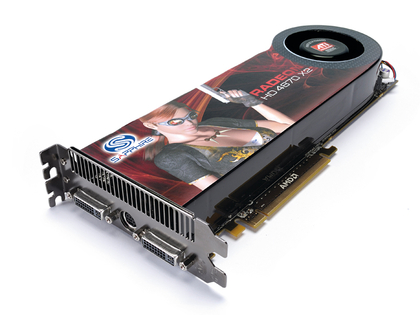
AMD Radeon 4870 X2 - rm340
For years both ATI and Nvidia had been trying to create a multi-GPU card that combined two graphics processors in one single card design. And both had failed quite impressively until the HD 4870 X2 hit the market proving that it coule be done and done right.
Like the rest of these older cards, The 4870 X2 isn't able to cope with the rigours of DX11, and the tessellated goodness it entails, but for general graphical performance it's got it where it counts.
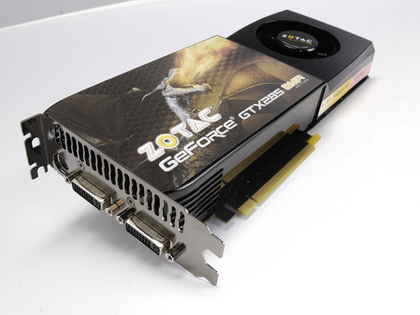
Nvidia GTX 285-rm320
This, the GTX 285, was Nvidia's fastest single-GPU card right up to the launch of the GTX 480.
It was the six-month refresh and die-shrink of Nvidia's thoroughly impressive, and mightily successful GTX 280 card.
The GT200b GPU beating at its heart packed in the same 1.4bn transistors in a chip that was actually over 100mm sq smaller, which is why it was able to ramp up the clockspeeds of this lightning fast DX10 card to such an extent.
And coming next Is the One of the must have GPU's for 2011..check this guys out..
AMD Radeon HD 5770
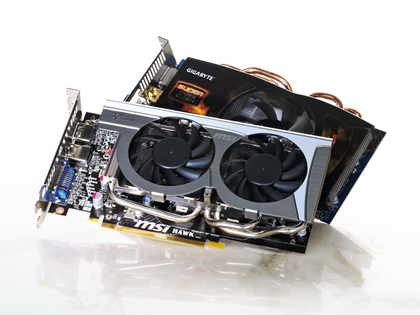
- Price: rm 480
- GPU: Juniper XT
- Manufacturing process: 40nm
- Memory: 1GB - 2,024MB GDDR5
For budget-conscious gamers, the HD 5770 should be a serious consideration. Have a scoot around the online retailers, and you'll see that examples can be had for less than £100 now,
Offering competent performance at the mainstream 24-inch resolution of 1920x1080, it also comes with the promise of cool-running, quiet operation - a trademark of AMD's current design philosophy. However, try and crank the shinier graphical elements - such as Anti-Aliasing and Anisotropic Filtering - too high, and the card starts to run out of grunt.
AMD's EyeFinity technology, which enables multi-screen scaling, is a very real option with the 5770, though we wouldn't recommend the 5770 for multi-screen gaming; it just doesn't have the throughput for gaming at huge resolutions.
But the really interesting thing about the HD 5770 is what its price represents. at these low prices, our thoughts turn to Crossfire setups. For under rm 600, you can net yourself a twin-card setup which offers kick-ass performance at mid-range resolutions.
If you're content with that 24-inch monitor and want zingy performance on a budget, this CF setup is probably the cheapest way to achieve it... and at a price equivalent to Nvidia's last-gen 285, which such a setup will blow out of the water, it's pretty mouth-watering. Oh, and did we mention the 5770 is DX11 capable? Yum.
And that's what that lower price-point really represents: the prospect of a twin-card CrossFire setup, and a pretty feisty one at that.
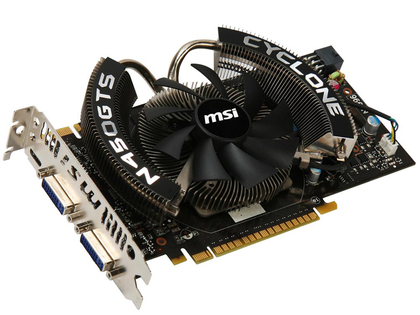
Nvidia GeForce GTS 450
- Price: rm 430
- GPU: GF106
- Manufacturing process: 40nm
- Memory: 1,024MB GDDR5
If 1680 x 1050 is the mass-market gaming resolution of choice, then the GTS 450 is opium for the masses.
This tiny powerhouse (well, it's still dual-width, but pleasingly short) is capable of feats beyond it rm350-rm500 pricetag. What's more, in SLI, you'll see massive performance gains, making the dual-card upgrade path a realistic and impressive option for budget systems.
The basic GeForce GTS 450 is, architecturally, about half of a GeForce 460 with a higher clockspeed and a narrower memory bandwidth. Given that stock versions of the 768MB version of the GeForce GTX 460 are available for just rm400 that extra rm50 is well spent.
However, the GTS 450 has the advantage over the GTX 460 of being smaller and requiring less power, which makes it a strong candidate for that SLI set-up
It is, however, now pitched directly up against the HD 5750 in pricing terms thanks to the on-going Nvidia/AMD graphics card price wars. And that is a card the GTS 450 happily beats into submission in any benchmark you throw at it.
THE BEST GRAPHIC CARD FOR THE YEAR 2011 IS
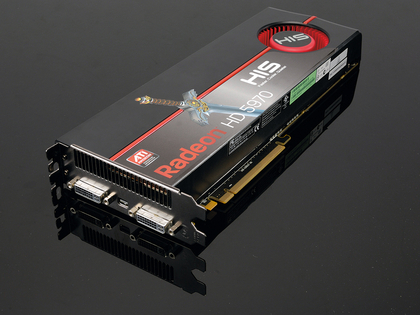
ATI Radeon HD 5970
- Price: £rm 650
- GPU: Hemlock XT (2 x RV870)
- Manufacturing process: 40nm
- Memory: 2 x 1,024MB GDDR5
So here it is; the fastest commercial graphics card available today; the Radeon HD 5970.
AMD has taken the top spot and managed to hold out against the latest Fermi card from Nvidia, the GeForce GTX 480.
This twin-GPU beauty is one big, beefy, powerhouse of a graphics card, capable of spewing out polygons like last night's bad kebab. And it since its launch, we've seen over £100 fall from the price-tag to keep the stock flowing.
It isn't just two HD 5870s strapped onto one slab of PCB though - there's definitely nothing simple about fitting two graphics cards into one form factor.
The actual GPUs are slightly slower than a vanilla HD 5870, making them more akin to twin overclocked HD 5850s. This also means that a Crossfire setup sporting two actual HD 5870s will beat this card in a foot race. But this is Crossfire made easy and that's something that could rarely be said in the past.
Surprisingly, given the power requirements, it doesn't get quite as hot as the volcanic GTX 480, a card that actually wiped some of our fingerprints during testing. And surprisingly, it's remarkably stable and happy to be overclocked.
Some would say that overclocking what is already the fastest graphics card in the world is a bit like overkill, but the option is there for the brave. There are concerns over driver support though, given that DX11 launch title, and AMD Game title DiRT 2 didn't support the multi-GPU HD 5970 until very recently, so like Crossfire in general, it could present compatibility questions going forward.
It's not as dear as it was, but it's still pricey, and what that means with both Nvidia and AMD refreshes on the horizon is anyone's guess. Ours would be: further price cuts. Affordability FTW!
And right now, it's still the fastest graphics card out there, posting figures with a healthy lead over the closest competitor from Nvidia. Considering that just a couple of generations ago ATI looked to be choking on Nvidia's dust with the HD 3xxx series of cards, it's quite incredible that it has managed to take the top spot and hold it against cards coming out almost half a year later.
Hats off to you then HD 5970, you are the fastest graphics card in the world.
by RipX studios inc'